
ESG mandates are reshaping how construction procurement decisions get made. Sustainability requirements are moving from optional certifications to baseline specifications — and the global sustainable construction market reflects that shift, currently valued at $545 billion and on track to reach $1.2 trillion by 2033. For contractors and precasters specifying concrete formliners, the environmental argument for high-reuse materials has never been stronger or easier to make.
The Construction Waste Problem — and Where Formliners Fit
Construction and demolition waste accounts for approximately 30% of all waste generated in the United States. Within that figure, concrete-forming materials represent a significant and often overlooked contributor. Single-use forming materials — plywood sheets, expanded polystyrene liners, disposable plastic molds — travel from the manufacturing plant to the job site to the landfill in a cycle that repeats with every pour.
Furthermore, this cycle generates more cost than most teams account for. Every single-use liner requires purchasing, shipping, handling, installation, and disposal. Multiply that across a project requiring hundreds of panels, and the resource expenditure becomes substantial — before you even consider the environmental footprint.
According to industry data, construction waste accounts for roughly 30% of all U.S. landfill contributions. Single-use concrete forming materials are a measurable share of that total — and a straightforward target for reduction through reusable alternatives.
Reusable formliners address this problem directly. However, the environmental case goes beyond simply reducing disposal volume. It encompasses energy consumption, raw material use, transport cycles, and the elimination of applied surface treatments that would otherwise require periodic reapplication.
How ESG Is Reshaping Construction Procurement
ESG — Environmental, Social, and Governance — criteria are no longer limited to financial sector reporting. Increasingly, large-scale construction clients, institutional project owners, and public agencies embed sustainability requirements directly into procurement frameworks. As a result, material selection decisions that were once purely driven by unit cost now carry ESG weight in the specification process.
What ESG Procurement Means in Practice
In practice, ESG procurement means that suppliers and subcontractors face questions they didn't face five years ago. Project owners want lifecycle assessments. General contractors need documentation of material reuse rates. DOT programs increasingly ask manufacturers to substantiate environmental claims with verified performance data rather than marketing language.
Additionally, LEED, BREEAM, and similar certification programs are becoming baseline requirements on institutional and commercial projects — not aspirational targets. Specifying materials with verified reuse performance supports those certifications in ways that single-use alternatives cannot.
Moreover, the September 2026 launch of the Sustainable Concrete Buyers Alliance — a coalition of major buyers coordinating to accelerate low-carbon concrete adoption — signals that procurement pressure is intensifying from the client side. Manufacturers and contractors who can demonstrate verified sustainability practices gain competitive advantage in this environment.
The Reuse Math: Single-Use vs. High-Reuse Formliners
The environmental case for reusable formliners becomes concrete — literally — when you run the pour-count math on a real project. Consider a retaining wall project requiring 150 panels, each cast with a textured formliner.
This math scales proportionally. Therefore, the larger the project — and the higher the panel count — the greater the environmental and economic advantage of specifying high-reuse material from the start.
Lifecycle Advantages Beyond Waste Reduction
Waste reduction is the most visible environmental benefit of reusable formliners, but it represents only part of the full lifecycle picture. Several additional factors contribute to the environmental case.
No Applied Finishes to Maintain or Replace
Applied surface treatments — paints, coatings, bonded veneers — require periodic reapplication over a structure's lifetime. Each reapplication cycle consumes materials, generates chemical waste, and demands labor and access equipment. By contrast, a formliner texture cast integrally into concrete requires no subsequent surface treatment. The texture is the finish, and it lasts for the full design life of the structure.
Reduced Transport Cycles
Additionally, each formliner replacement requires a procurement, shipping, and delivery cycle. High-reuse formliners eliminate most of those cycles from the project's carbon footprint. On large infrastructure projects where formliners might otherwise require replacement multiple times during construction, this reduction in transport-related emissions becomes meaningful.
Elimination of Adhesive and Chemical Waste
Applied decorative systems — bonded stone veneers, glued tiles, coated surfaces — rely on adhesives and chemical bonding agents that generate their own waste streams. Furthermore, when those systems fail over time, as they inevitably do, the repair and replacement process generates additional material and chemical waste. Integral formliner textures have no adhesives, no chemical bond agents, and no delamination failure mode.
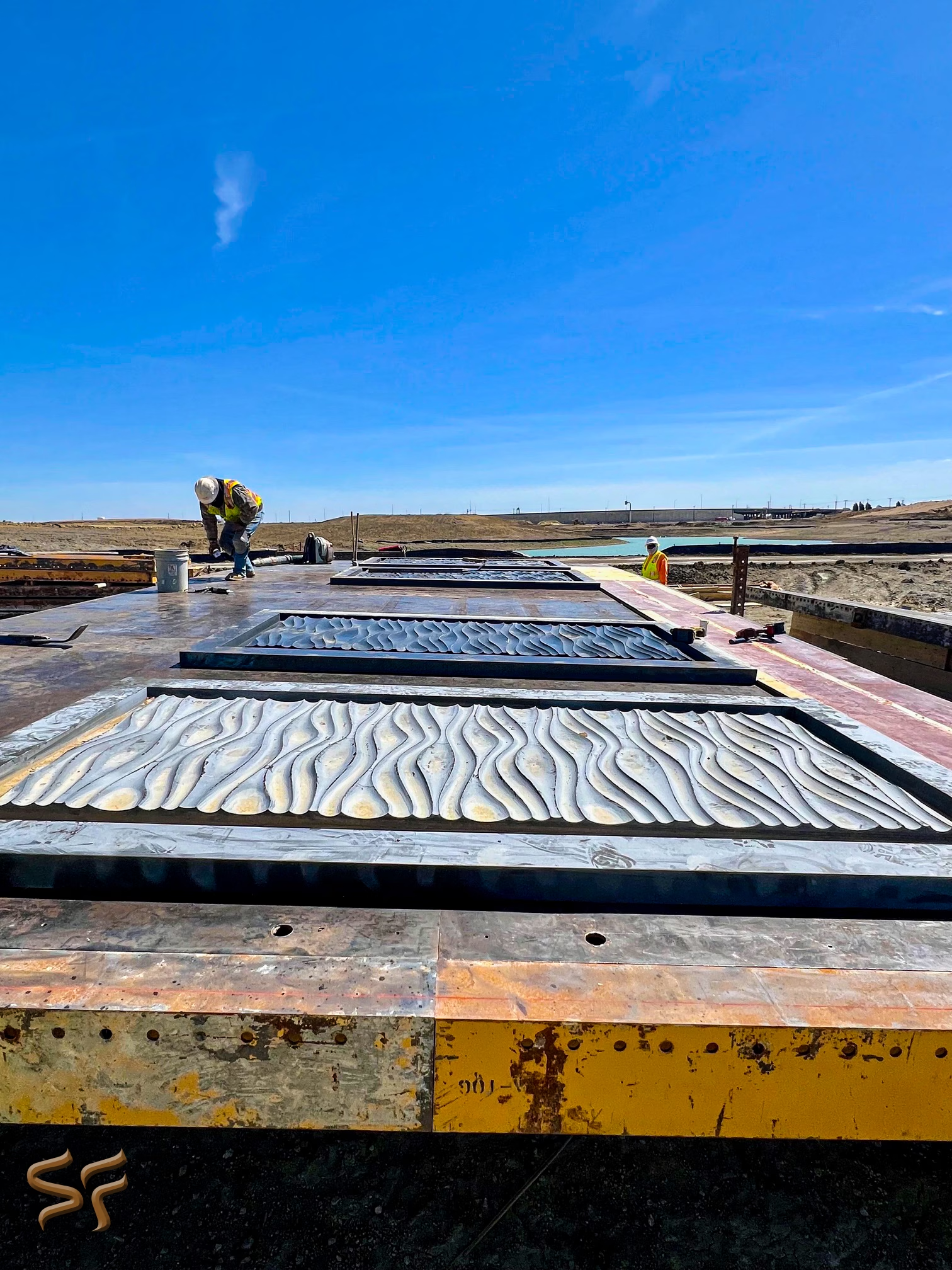
Formliners and Green Certification Programs
Architects and project owners pursuing LEED certification, BREEAM accreditation, or other green building standards increasingly evaluate forming systems as part of the overall material sustainability picture. While formliners are not themselves a direct LEED credit category, they contribute to several key areas of certification frameworks.
In January 2026, the American Concrete Institute and the Global Consensus on Sustainability in the Built Environment signed a formal agreement to advance sustainable concrete construction through shared technical expertise. The industry's direction is clear — and material selection decisions are at the center of it.
Choosing the Right Material for Your Sustainability Goals
Not every project has the same sustainability requirements — or the same budget. Fortunately, the reusable formliner category offers options across the full spectrum of project scale and reuse expectation.
- SpecVac Multi-Use Plastic (2–10 uses) — Bridges the gap between single-use and high-reuse for smaller projects. Consequently, it reduces disposal volume compared to single-use while keeping unit costs manageable on budget-sensitive work.
- ElastoSpec-Lite Semi-Elastomeric (15–25 uses) — Delivers durable, deep-relief performance for mid-scale projects with moderate reuse expectations. Additionally, it supports custom patterns without the full cost of premium elastomeric.
- ElastoSpec Full Elastomeric (25+ uses) — The benchmark for large-scale infrastructure and DOT work where maximum reuse, pattern fidelity across hundreds of panels, and full lifecycle documentation are required. Moreover, it delivers the lowest total cost per pour of any material in the lineup.
The right choice depends on panel count, project schedule, and sustainability documentation requirements. However, across all three options, every step up the reuse ladder reduces the project's environmental footprint relative to single-use alternatives.
How Spec Formliners Supports Sustainable Specification
Sustainability claims in the construction industry often outpace the supporting documentation. At Spec Formliners, reuse performance data comes from in-house manufacturing and quality control — not third-party estimates. Every material we produce carries a verified reuse rating based on real production and field performance, not marketing assumptions.
Our Sustainability-Aligned Capabilities
Ready to Make the Sustainable Choice?
Talk to our team about reuse ratings, pour-count analysis, and the right formliner material for your project's sustainability goals.