Architecture's highest honor and a suburban parking structure seem to occupy entirely different worlds. One earns international recognition. The other earns complaints about the entry gate. But strip away the context, and both rely on the same fundamental material decision: what does the concrete surface look like, and what does it communicate about the people and places around it? The answer to that question doesn't require a landmark budget. It requires intention.
How Award-Winning Architects Use Concrete Texture
The Pritzker Architecture Prize — often described as architecture's equivalent of the Nobel Prize — has consistently recognized architects whose work demonstrates mastery of materiality. Notably, concrete appears throughout the portfolios of many of the award's most celebrated recipients.
Tadao Ando: Texture as Spatial Experience
Tadao Ando, awarded the Pritzker Prize in 1995, built an entire architectural philosophy around the expressive surface of concrete. His Church of the Light, the Museum of Wood Culture, and numerous residential projects use deeply considered concrete textures to define spatial character. Specifically, the interplay between light, shadow, and surface relief in his work demonstrates how a forming decision — made before a single cubic yard of concrete is poured — shapes the experience of a finished space.
Liu Jiakun: Concrete as Cultural Memory
Liu Jiakun, the 2025 Pritzker Prize winner, uses exposed concrete walls as primary architectural surfaces throughout his body of work. In his Luyeyuan Stone Sculpture Art Museum — a building set in a bamboo forest in Chengdu — exposed concrete walls create the primary atmosphere of the interior. Additionally, his approach consistently treats the concrete surface not as a substrate waiting for a finish, but as the finish itself. The texture of the wall is the design.
"In a world that tends to create endless dull peripheries, he has found a way to build places that are a building, infrastructure, landscape and public space at the same time."
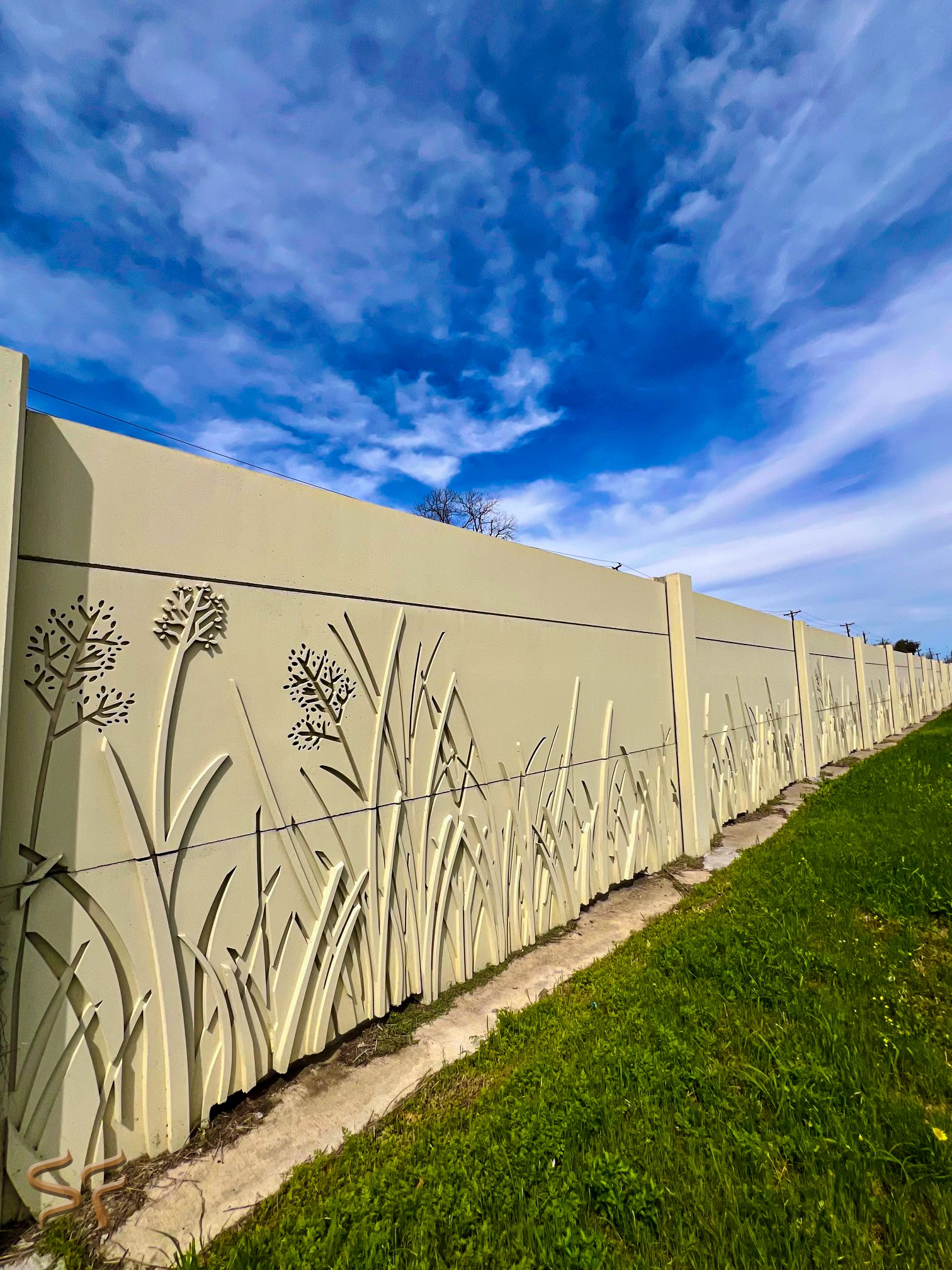
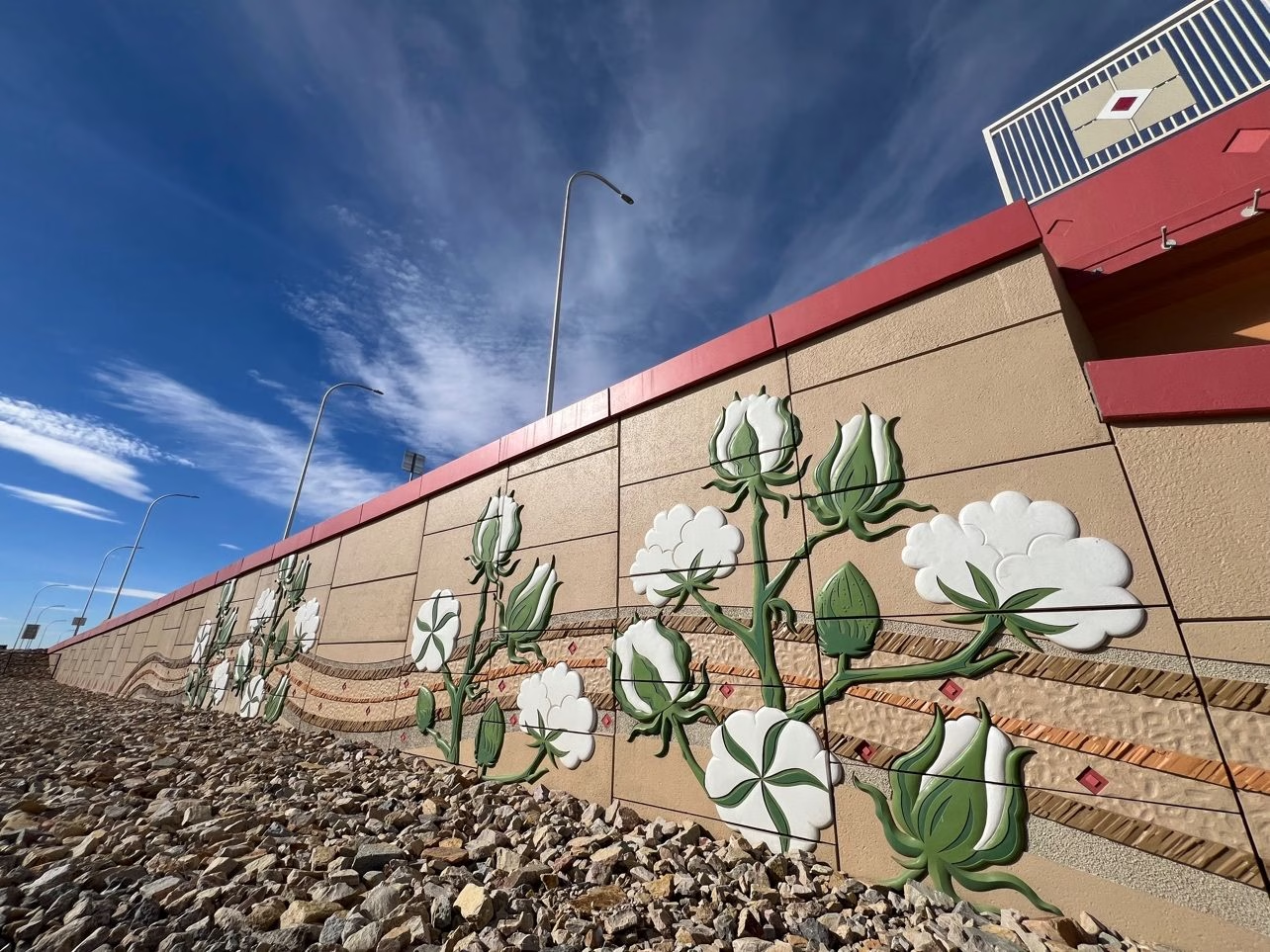
— Alejandro Aravena, Pritzker Prize Jury Chair, on 2025 laureate Liu JiakunThat description of Liu Jiakun's work — buildings that function simultaneously as infrastructure and public space — applies equally well to what architectural formliners accomplish on sound walls, bridge abutments, and retaining walls. The ambition is the same. The technology is the same. Only the scale and setting differ.
The Perceived Gap vs. the Real Gap
The conventional assumption is that architectural concrete quality scales directly with budget. Landmark buildings have landmark budgets; therefore, they get landmark surfaces. Parking garages, retaining walls, and utility structures have utilitarian budgets; therefore, they get utilitarian finishes.
However, this assumption misidentifies where the real gap lies. The difference in surface quality between an award-winning concrete building and a bare-grey parking deck is not primarily a function of budget. It is a function of when the surface question gets asked.
The Specification Timing Problem
On prestigious architectural projects, the surface of the concrete is a design question that gets resolved in schematic design — sometimes before the structural engineer is engaged. By contrast, on infrastructure and utility projects, the surface question often gets addressed as an afterthought, if at all, after structural and mechanical decisions have already been locked in.
Consequently, the gap between good and forgettable concrete is primarily a gap in timing and intention — not in technology or budget. Architectural concrete formliners cost a fraction of what most non-specialists assume. Moreover, they add negligible complexity to the forming and casting process when specified correctly from the start.
What Actually Separates Good Concrete from Forgettable Concrete
If budget isn't the primary differentiator, what is? Based on decades of working alongside architects, contractors, and precasters across every project type and scale, the answer comes down to four decisions — none of which require a landmark budget to execute well.
The single most important decision is asking what the concrete surface should look like before structural and formwork decisions lock in. Specifically, projects where the architect or engineer designates the formliner type at the specification stage — not the contractor at the ordering stage — produce consistently better results. Early involvement costs nothing. Late involvement costs significantly more.
Pattern selection should reflect the context of the structure, the viewing distance of the audience, and the environmental conditions the surface will face. A pattern that communicates something — natural stone that references the surrounding landscape, geometric texture that echoes the building's structural rhythm, community-specific imagery that connects the structure to its place — performs better in every measurable way than a pattern chosen for convenience.
Material type determines surface quality, consistency across panels, and performance over time. However, it also determines the total project cost — not just the per-liner price. Specifying an elastomeric liner on a 200-panel project costs more per liner than a plastic alternative. Nevertheless, the total cost including rework, rejected panels, and replacement liners often makes the high-reuse option the lower-cost choice overall.
The difference between a wall that looks designed and a wall that looks assembled is often seam placement. Award-winning concrete projects treat seam location as a design decision. On most conventional projects, seams go wherever they're convenient. Consequently, the finished surface reveals every joint — not because the pattern failed, but because continuity wasn't considered in the layout stage.
Everyday Applications, Extraordinary Results
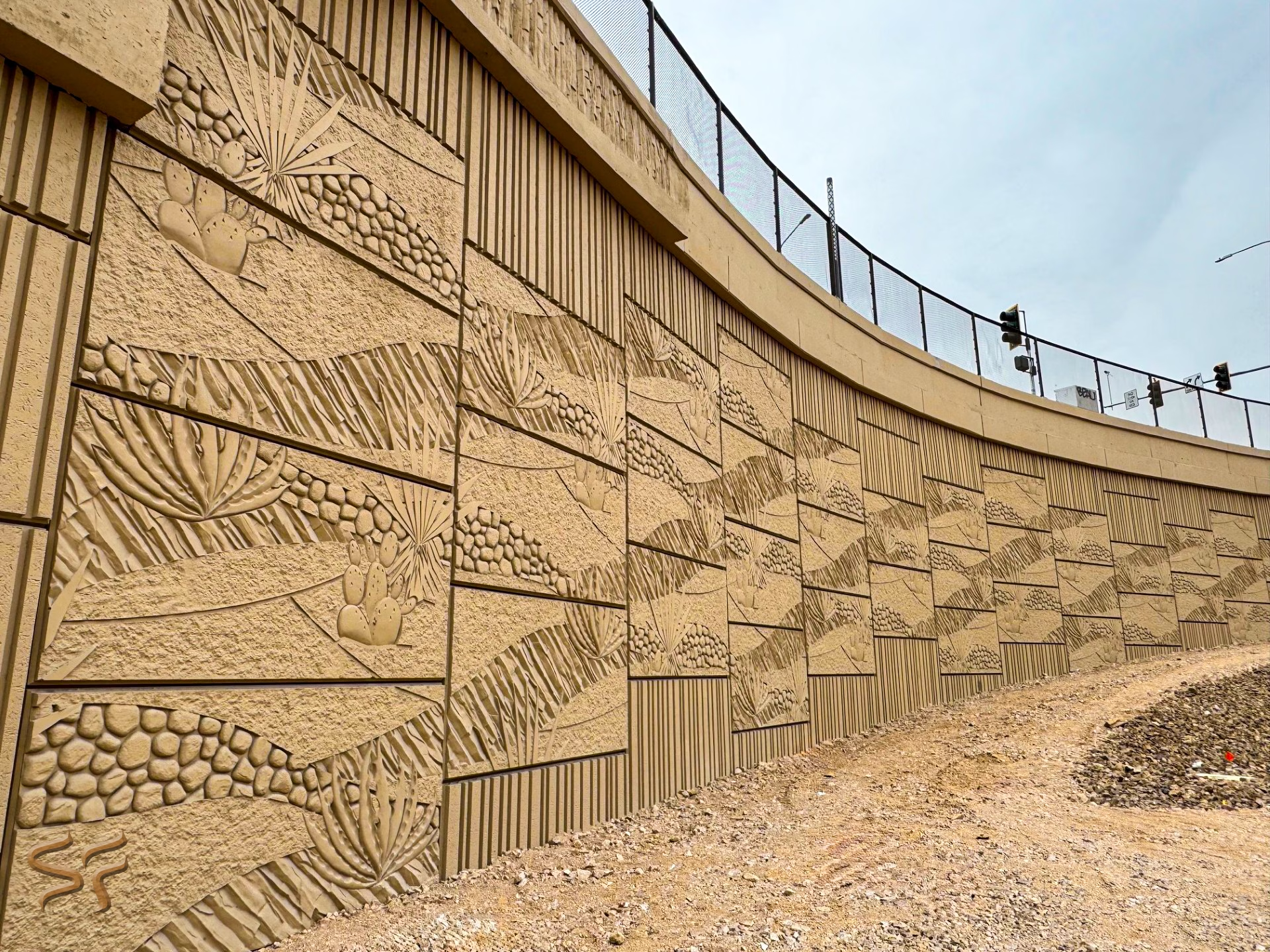
The project types that benefit most from this democratized access to architectural concrete quality are precisely the ones that have historically received the least design attention.
A Decision Framework for Any Budget
The goal isn't to turn every parking garage into a Pritzker-caliber building. Rather, it's to ask one question at the right moment in every project: what should this concrete surface communicate?
That question, asked early enough to influence the specification, costs nothing. The answer drives pattern selection, material choice, and seam strategy — all of which happen within the normal scope of a forming and casting decision. Consequently, the upgrade from bare grey concrete to a considered architectural surface requires less budget than most teams assume, and less complexity than most contractors fear.
How Spec Formliners Helps You Get There
We work with architects, contractors, and precasters at every budget level — from standard infrastructure specifications to fully custom community mural programs. Our pattern library includes over 400 designs across natural stone, wood grain, geometric, brick, and custom categories. Additionally, our in-house design team helps clients find the right pattern for the right context, whether that's a DOT sound wall, a municipal building, or a parking structure that has more potential than its program suggests.
The technology that defines award-winning architectural concrete is not proprietary to landmark projects. It's available to any project that asks the question early enough. We're here to help you ask it.
The best concrete surfaces aren't a function of budget. They're a function of intention — and intention costs nothing to add to a specification.
Ready to Bring Intention to Your Next Project?
Explore our pattern library, request samples, or talk to our team about what's possible on your project — at your budget.