Infrastructure tells stories. Every bridge, every overpass, every retaining wall has the potential to do more than serve its structural purpose; it can honor history, celebrate culture, and connect communities to the land and waters that have sustained them for millennia. At Spec Formliners, we've long understood that our work transcends technical specifications and pattern catalogs. When we collaborate with artists, architects, and Indigenous communities to translate vision into textured concrete, we're participating in something profoundly meaningful. We're helping permanent structures speak in ways that matter.
The Pattullo Bridge Replacement Project in Surrey, British Columbia, is a prime example of collaborative potential. In this project, custom urethane formliners served as the medium through which Indigenous stories, ecological knowledge, and cultural heritage were permanently integrated into key infrastructure.
Preserving Indigenous Stories: The Pattullo Bridge Replacement
Stories flow like rivers, and sometimes infrastructure becomes the vessel that carries them forward. The new bridge replacing the 88-year-old Pattullo Bridge isn't just a transportation solution; it's a cultural statement, a recognition of the deep historical connections First Nations have to this land.
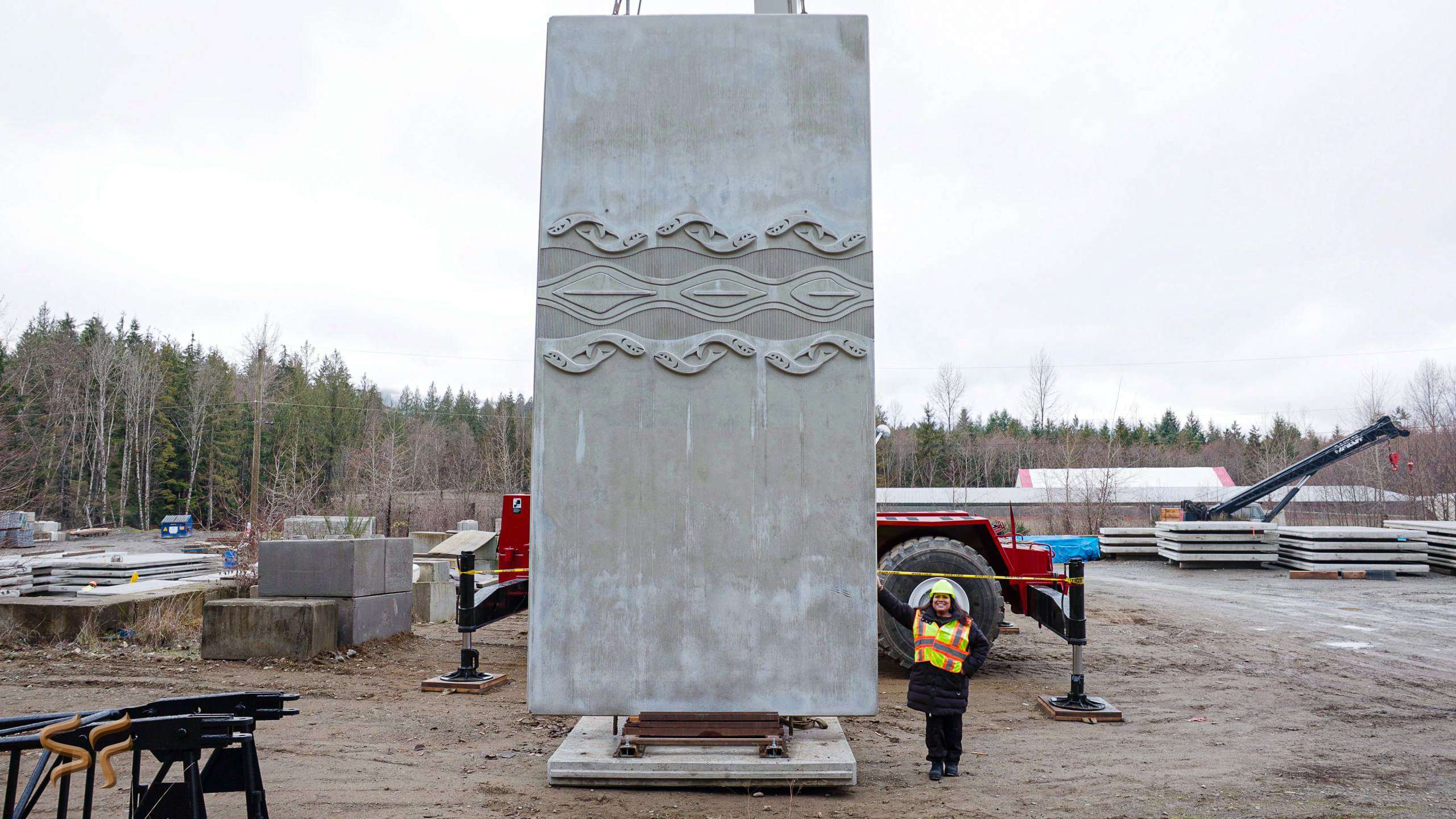
Working with MSE Precast in Qualicum Beach, we contributed custom urethane formliners to a project featuring stunning Indigenous artwork by Kwantlen First Nation artist q̓ʷɑt̓ic̓ɑ (Phyllis Atkins). Her design, now embossed into the concrete retaining wall along the northeast side of the Highway 17 overpass at Old Yale Road, highlights sturgeon and eulachon, two species deeply rooted in the history and ecology of the Fraser River.
The engraved textures include detailed replicas of sturgeon scutes: the distinctive diamond-shaped bony plates that make these ancient fish so unique. These aren't merely decorative patterns. They're educational elements, conservation messages, and cultural tributes rendered in concrete that will endure for generations.
The Artist's Connection to the River
Phyllis Atkins drew her inspiration from years of hands-on research studying the Fraser River and its inhabitants. In an interview with CBC News, she reflected on the profound impact of her work: "It was life-changing being right on the river in our unceded traditional territory of Kwantlen. We had sites right up and down the Fraser. I got to see firsthand the perspective of the river our people used to travel and fish for thousands of years. I really felt that connection."
Her design speaks to multiple layers of meaning. The sturgeon scutes came from a female white sturgeon that died with a full row of scutes still in her belly, found just upstream of q̓ʷɑ:nƛ̓ən. This fish was believed to be approximately 75 years old or more, a living connection to the past that Atkins transformed into an artistic legacy.
In the artist's words: "My design resembles a Salish wool weaving and the back of a sturgeon with the male and female eulachon intertwining like the Salish wool, cedar, and bulrush twining weave."
The artwork is dedicated to her friend Garrett Martindale of the Sts'ailes First Nation, who worked with Atkins on white sturgeon acoustic telemetry studies. This personal dedication adds another dimension to the work; it's not just about fish or patterns, but about relationships, collaboration, and shared commitment to conservation.
Technical Collaboration: Translating Art into Durable Concrete
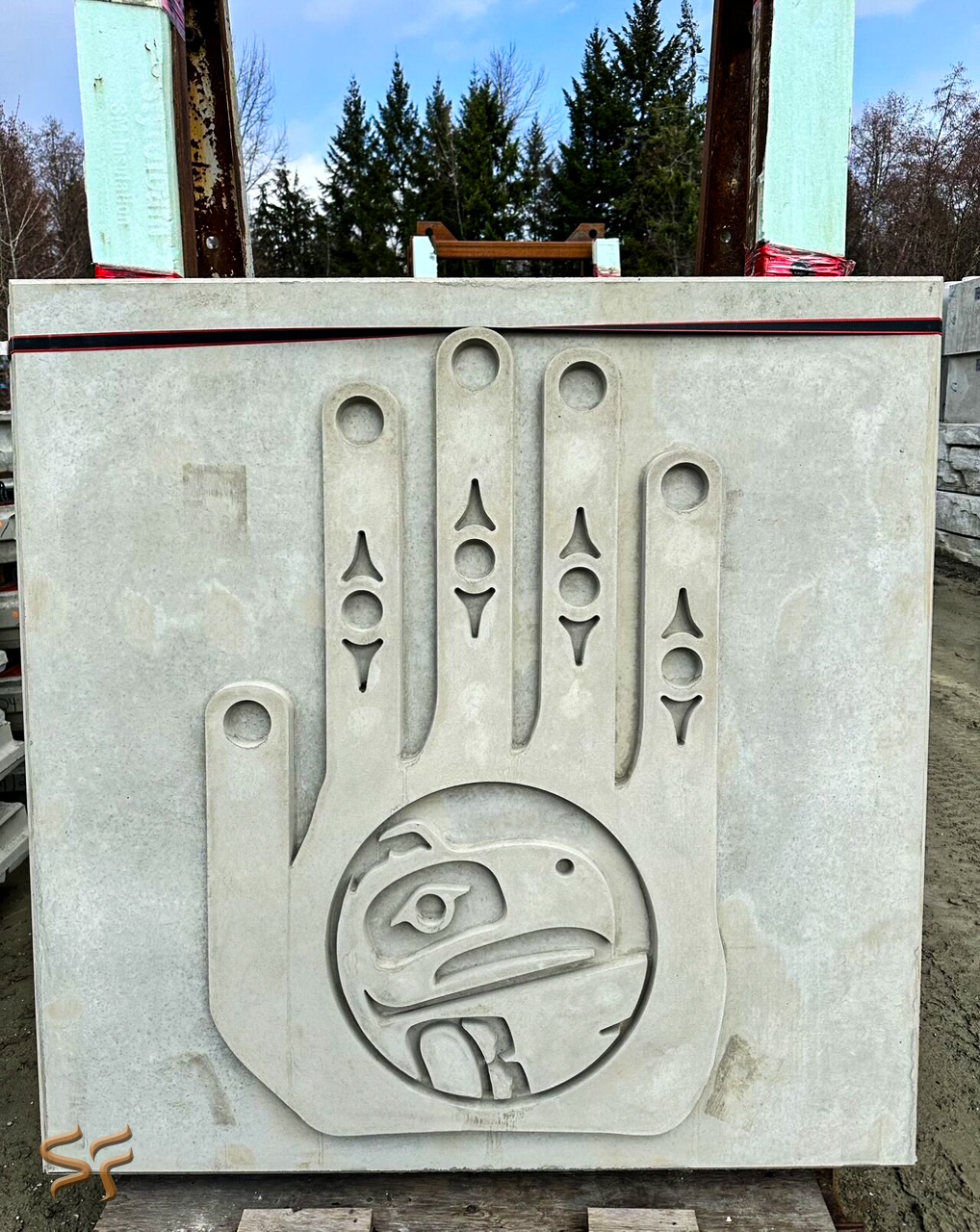
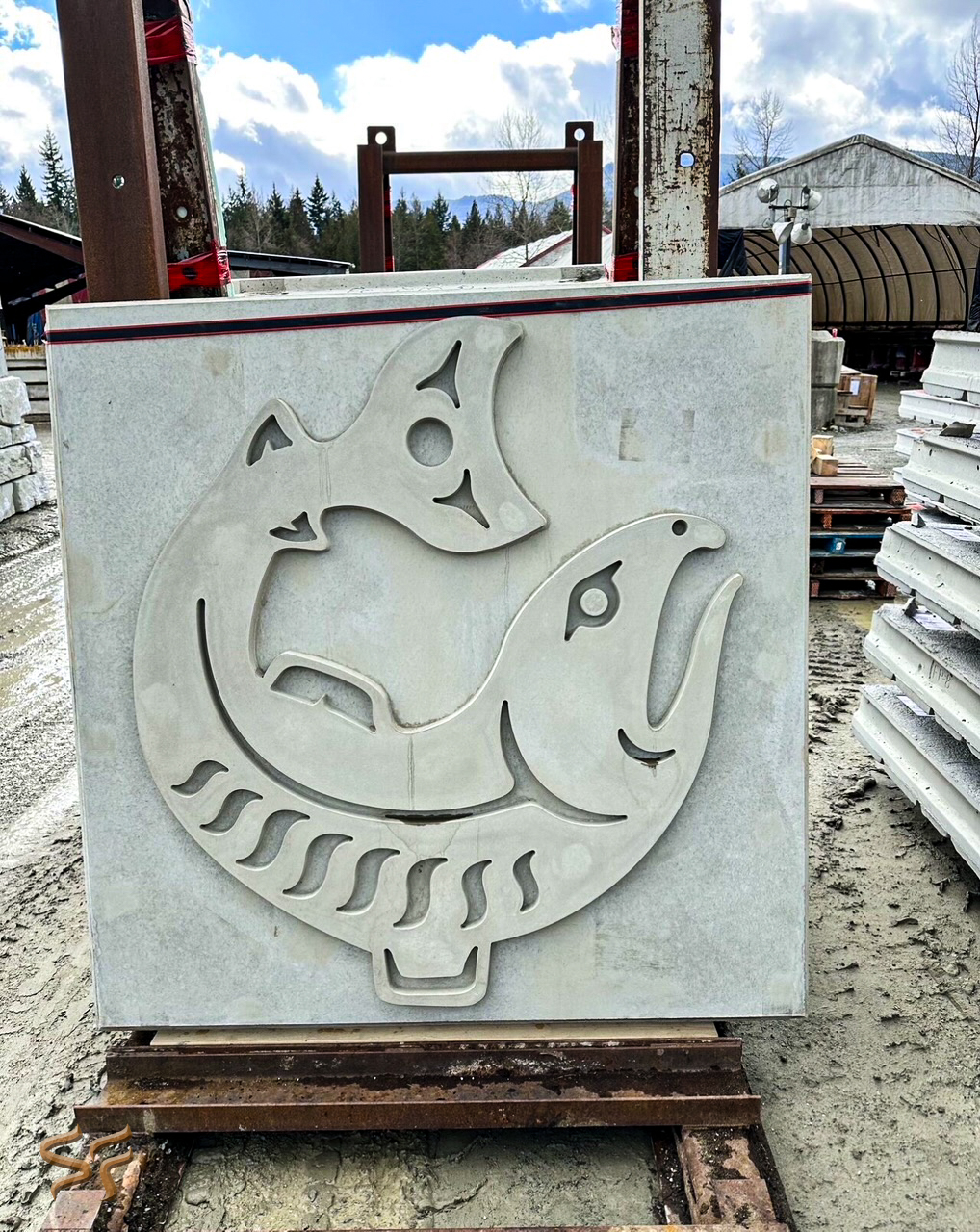
Creating custom formliners for Indigenous artwork requires more than technical proficiency; it demands sensitivity, precision, and collaboration at every stage. When Phyllis Atkins visited MSE Precast in December 2023 to review sample panels, she wasn't just approving a product. She was ensuring that her cultural knowledge, artistic vision, and ecological message would be accurately and respectfully reproduced.
The challenges in this type of work are substantial:
Pattern Complexity
Traditional Salish weaving patterns feature intricate geometric designs that must be captured with precision. The intertwining of male and female eulachon within the larger pattern required careful attention to depth, relief, and detail.
Biological Accuracy
The sturgeon scutes needed to be more than stylized representations; they had to be recognizable as the actual anatomical features that distinguish these ancient fish. This required close reference to real specimens and scientific knowledge.
Durability Considerations
The formliners needed to withstand the demands of precast concrete production while maintaining the fine details that make the artwork meaningful. Our urethane formliners provided the flexibility and durability necessary for successful concrete casting.
Cultural Sensitivity
Throughout the process, we understood that this wasn't simply a commercial transaction. The patterns carry cultural significance, and our role was to serve as faithful translators of the artist's vision into a different medium.
A Broader Cultural Recognition Program
The Highway 17 overpass artwork represents just the first installation in a comprehensive First Nations cultural recognition program tied to the $1.637 billion bridge replacement project. According to the official project documentation, the program uses "artwork, storytelling, language, and signage as an opportunity for education, acknowledgment, and celebration of the culture, history, and continued stewardship of the Project area's lands and waters."
In the coming months, additional Indigenous artwork will be installed on the lower piers, upper tower, and crossbeam of the new bridge itself. First Nations artists are exploring themes of kinship-based trade, transportation, and intergenerational connection, themes that will be permanently visible to the thousands of people who cross this infrastructure daily.
The project area overlaps with the boundaries of two former reserves: Musqueam Indian Reserve No. 1 and Kwantlen Indian Reserve No. 8, both located in qiqéyt, an important village site for First Nations. This geographical and historical significance makes the integration of Indigenous art particularly appropriate.
Perhaps most significantly, the new bridge will not retain the 88-year-old "Pattullo" name. Instead, the Musqueam Indian Band and Kwantlen First Nation are collaborating to bestow a new name in the hən̓q̓əmin̓əm̓ language, a profound gesture of recognition and reconciliation.
Why Custom Formliners Matter for Cultural Projects
This project exemplifies why custom formliners are uniquely suited for cultural recognition and artistic expression in infrastructure:
- Permanence — unlike applied finishes or separate art installations, formliners create texture that's integral to the concrete itself. The patterns will last as long as the structure stands, potentially a century or more
- Scale — formliners allow artwork to be expressed at the scale of infrastructure itself. These aren't small plaques or standalone sculptures; they're building-scale expressions embedded into functional elements
- Durability — when artwork is embossed directly into concrete surfaces, it withstands weather, vandalism, and time with minimal maintenance required
- Accessibility — by integrating art into retaining walls, bridge elements, and overpasses, the artwork becomes freely accessible to all community members
- Educational opportunity — large-scale concrete art creates natural opportunities for interpretation and education. Travelers beneath the overpass can't help but notice the intricate patterns
The Spec Formliners Approach to Artist Collaboration
Our work on the Pattullo Bridge project reflects the approach we bring to all custom artistic collaborations:
- 1
Listening First
We begin by understanding what the artist or community wants to express. Technical considerations come second to the vision itself.
- 2
Sample Development
Physical samples allow artists to see and touch how their designs translate into three-dimensional texture. This iterative process ensures the final product meets expectations.
- 3
Technical Problem-Solving
Our experience allows us to guide artists around potential technical challenges without compromising their vision. We understand concrete behavior, release characteristics, and production requirements.
- 4
Material Selection
We match formliner materials to the specific needs of each project, considering factors like pattern complexity, number of uses required, and production environment.
- 5
Quality Assurance
Throughout manufacturing and installation, we maintain contact with all stakeholders to ensure the vision is preserved from concept through completion.
Beyond Aesthetics: Infrastructure with Meaning
The Fraser River has been actively used by First Nations since time immemorial for fishing, harvesting, and other essential activities. The white sturgeon, the largest freshwater fish in the world, can live for over 100 years and represents a living link to that ancient past. Eulachon, small silver fish from the smelt family, were deemed endangered in 2011, making their depiction a conservation message as well as a cultural reference.
When infrastructure acknowledges this deep history, when it incorporates Indigenous knowledge and artistry, it becomes more than functional; it becomes meaningful. It tells a more complete story about the place it occupies and the people connected to that place.
This is the potential that exists when artists, engineers, fabricators, and communities work together with intention and respect.
Looking Forward: Infrastructure as Cultural Canvas
As the new Pattullo Bridge (soon to receive its hən̓q̓əmin̓əm̓ name) nears completion, it will stand as an example of what's possible when we think beyond purely utilitarian infrastructure. The bridge will provide a safer crossing with wider lanes, protective barriers, and dedicated pathways for pedestrians and cyclists, but it will also provide something less tangible and perhaps more valuable: recognition, education, and beauty.
For us at Spec Formliners, projects like this reinforce why we do what we do. Yes, we manufacture technical products that meet engineering specifications. But we also have the privilege of helping artists and communities leave a lasting mark on the landscape, stories told in concrete that will endure for generations.
Whether you're an architect designing a cultural center, a tribal nation seeking to incorporate traditional patterns into new construction, or an artist with a vision for public art that can withstand the elements, custom formliners offer a proven pathway from concept to concrete reality.
Ready to Tell Your Story in Concrete?
Every project has a story. Every place has meaning. Our custom design process begins with conversation, not calculation. We want to understand your vision before we talk about technical specifications. What story could your next project tell?